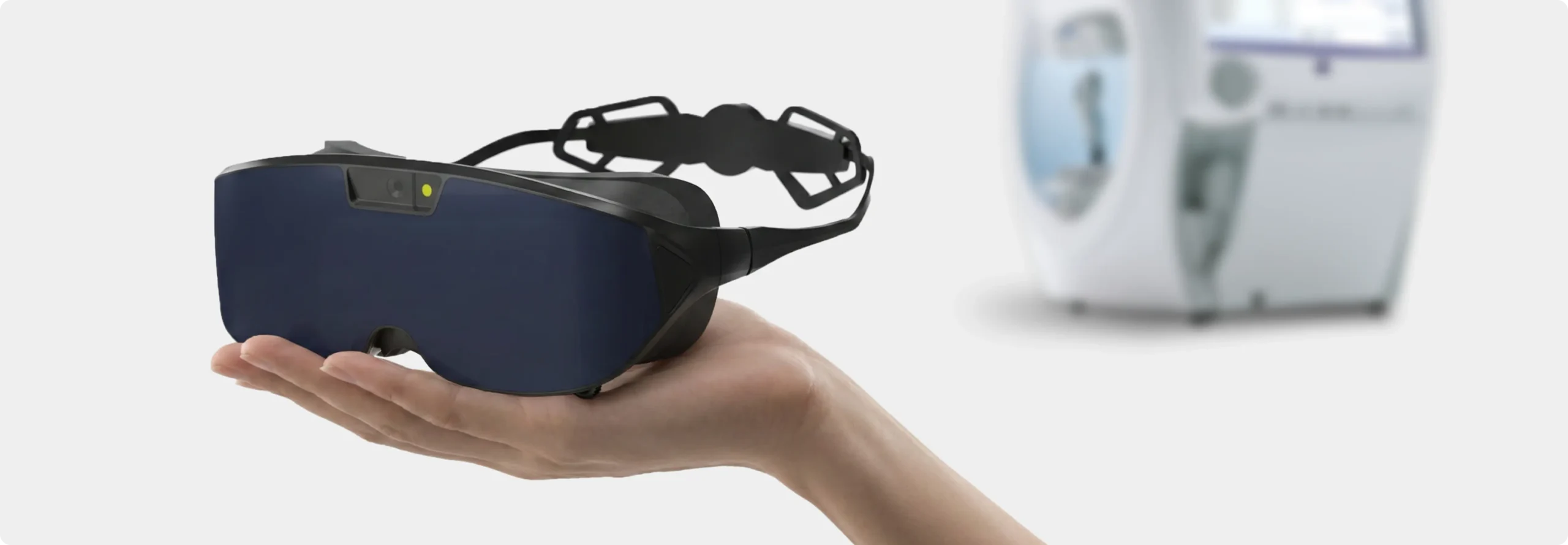
Brink Surgical Vision Institute is a high-volume surgical practice led by Matthew Brink, MD. As a glaucoma specialist making surgical decisions that carry significant consequences for patients, Dr. Brink depends on visual field testing that aligns with long-standing perimetry standards while supporting modern clinical workflows.
Like many specialists, his surgical training and evidence-based decision-making were built around traditional bowl perimetry. Decades of published studies, established algorithms, and longitudinal data have shaped how clinicians interpret progression and determine when to intervene. Any new technology entering this space must integrate into that framework without compromising clinical confidence.
For Dr. Brink, adopting a headset perimeter was not about novelty. It was about maintaining control over the entire testing process and ensuring that reproducibility and correlation with established standards were sufficient to support surgical precision.
Visual field interpretation is both analytical and experiential. Over time, clinicians develop an internal pattern-recognition system based on thousands of perimeter reports. Progression analysis becomes a rapid, intuitive process grounded in precedent.
The challenge with emerging headset technologies is trust and confidence.
Devices originally designed for gaming prioritize immersive experiences, vibrant, saturated colors, and an entertainment-driven design. Those priorities differ from the needs of glaucoma specialists who require controlled testing environments and reproducible data that correlate closely with historical standards.
Dr. Brink describes glaucoma specialists as incremental adopters. Clinical processes evolve gradually and only when supported by sufficient data. To transition away from traditional bowl perimetry, a new device must:
Without those elements, adoption would stall regardless of technological promise.
From Dr. Brink’s perspective, Inspire® by RadiusXR® distinguishes itself by prioritizing reproducibility from the outset.
Rather than repurposing consumer hardware, the system was built around a single clinical objective: to document visual field progression reliably, supporting surgical decision-making. The emphasis on statistical rigor and controlled design gave Dr. Brink confidence before he even placed the device on a patient.
One early experience reinforced that trust. While trialing the device, a patient’s binasal visual field test revealed an unusual binasal visual field defect. Expecting an anomaly, Dr. Brink repeated the test using a traditional bowl perimeter. The results were identical. The defect reflected a neurological issue rather than a device error. For him, this edge case demonstrated a strong correlation with the established standard and reinforced confidence in the system.
Designed to Integrate with Clinical Habit
The reports from Inspire match exactly what you would expect from traditional perimetry reports, allowing physicians to rely on established interpretive instincts. Dr. Brink describes visual field reading as an internalized process built over years of research and development. The ability to plug into that existing cognitive framework was essential.
By initially matching established thresholds and presentation formats, the device earns clinician trust before expanding into future innovations.
Cloud-Based Progression Analysis
RadiusXR’s cloud infrastructure adds flexibility without sacrificing familiarity. Dr. Brink can log in to the system within seconds and review point-by-point progression from any of his locations and in any lane, either on his tablet or desktop device.
This accessibility supports:
The interface presents familiar data in a cleaner and more accessible format, broadening usability beyond physicians deeply focused on progression analytics.
Adaptability in a High Volume Practice
As a solo practitioner in a compact space, flexibility is critical. The headset perimeter can move between rooms and does not require a dedicated dark room. Exam rooms, waiting areas, or ad hoc testing scenarios can accommodate testing as needed.
For patients with neck or mobility limitations, the headset format offers a more comfortable experience than traditional bowl testing. According to Dr. Brink, this shift has improved willingness to complete visual field testing and strengthened compliance over time. It also allows his staff to use wait times when patients would otherwise be sitting idle in the lane.
Clinical Confidence in Surgical Decisions
For Dr. Brink, the most important outcome is confidence in making surgical decisions. The combination of reproducibility, strong correlation with historical standards, and consistent outputs supports a reliable interpretation of progression.
As he explains:
“That’s what gives me the most faith in the device. I felt confident going in from day one that the reproducibility was good enough that I could make surgical decisions.”
In a specialty where delayed detection and false alarms both carry consequences, dependable testing is essential. The device provides a balance between maintaining established thresholds and minimizing unnecessary noise.
Workflow Efficiency
The ability to convert any space into a visual field lane has improved clinic flow. Testing can be performed immediately when suspicion arises, eliminating delays and additional scheduling. Now our visual field equipment can hang on the wall along with common exam lane equipment.
In a high-volume environment, this flexibility contributes to smoother operations and a more streamlined patient experience.
Patient Comfort and Compliance
Patients who previously struggled with traditional bowl perimetry due to neck discomfort or positioning challenges have responded positively to the headset format. Increased comfort has translated into greater consistency in completing recommended testing.
Improved compliance strengthens longitudinal data collection, which is critical for progression analysis.
Continuous Platform Evolution
Over-the-air updates introduce new capabilities without hardware replacement. New testing options and refinements appear within the system, reflecting a platform designed to evolve over time.
For Dr. Brink, the transition from traditional bowl perimetry is no longer theoretical. His legacy device now sits unused. What excites him most is not only the ability to match established standards, but the long-term potential to build upon them as more data accumulates.
By earning trust first and innovating responsibly, Inspire has positioned itself as a reliable and forward-looking solution for glaucoma specialists.
Mon – Fri 5:00 am – 5:00 pm PST